Nuvetra Pest ManagementNuvetra Pest Management

Turf Insect and Fire Ant Lawn Solutions Mobile

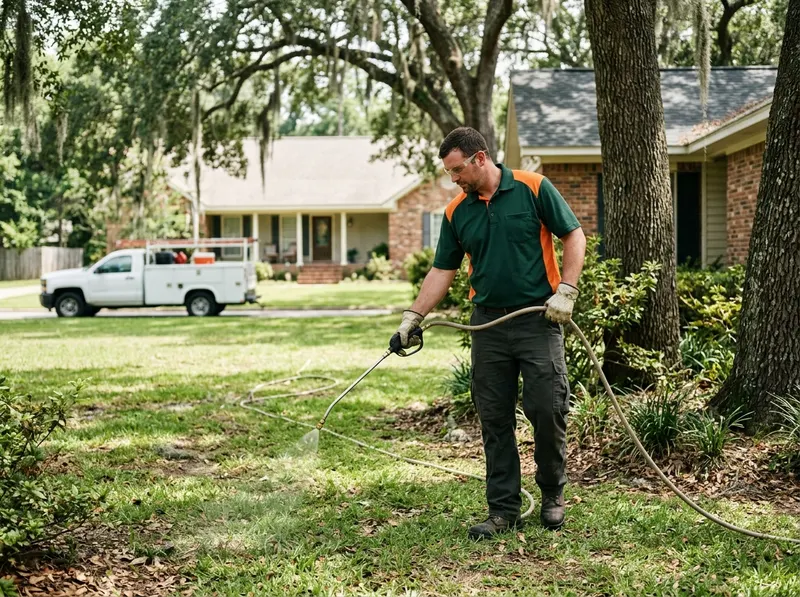
Warm-season turf species across Mobile County, predominantly St. Augustine, Centipede, and Zoysia, face aggressive biological pressure from subtropical moisture and high soil temperatures. In historical properties…
Get My Free Estimate →(251) 426-9782
Turf Insect and Fire Ant Lawn Solutions in Mobile, AL
Quick answer
  • What is included: Full-yard perimeter evaluation, granular soil broadcast, direct fire ant mound drenches, and root-depth subsurface saturation.
  • How fast: Treatments show active surface mortality within 24 to 48 hours, with colony elimination establishing within 7 to 14 days.
  • What it costs: Ballpark pricing spans $150 to $375 per service depending on acreage and infestation severity; exact cost confirmed on-site.
  • Target species: Red imported fire ants, southern chinch bugs, sod webworms, mole crickets, and white grubs inhabiting residential sod.
  • Booking access: Scheduling requires a brief exterior property review; homeowners can confirm appointments at (251) 426-9782.

Warm-season turf species across Mobile County, predominantly St. Augustine, Centipede, and Zoysia, face aggressive biological pressure from subtropical moisture and high soil temperatures. In historical properties throughout Midtown, Oakleigh Historic District, and Church Street East, heavy live oak canopies retain surface moisture that supports damp soil pests, while open, sun-baked lawns in Spring Hill, Cottage Hill, and Llanfair frequently endure severe southern chinch bug feeding that mimics drought stress. Imported red fire ants construct subterranean galleries up to 4 to 6 feet deep in coastal sandy loam, emerging after seasonal rainfall around Bertha Hills and Ashland Place to build hazardous surface mounds. Standard topical pest sprays wash away during heavy coastal downpours; professional turf management instead relies on water-activated granular residual controls bound to thatch layers, alongside systemic root uptake that intercepts xylem-feeding insects before leaf chlorosis and turf death occur.

Selecting whole-yard residual broadcast applications fits properties experiencing recurring mound development across open play zones or widespread turf yellowing. A targeted spot-mound drench resolves visible individual colonies along walkway borders near Hannon Park, yet spot treatments fail to deter satellite queens nesting beneath underlying turf roots, leading to re-infestation within 21 days. The operational trade-off centers on upfront coverage versus frequency: a broadcast residual treatment requires a higher initial investment starting at the $150 service minimum, yet it protects sod density for up to 6 to 12 months, avoiding the repetitive labor of chasing individual surface mounds. Property managers and homeowners near the University of South Alabama and Ladd-Peebles Sports & Entertainment Complex maintain safer outdoor boundaries by establishing continuous chemical barriers that stop mound migration into porch foundations, HVAC pads, and interior living quarters.

Turf Insect and Fire Ant Lawn Solutions cost in Mobile

Quarter-Acre Lot Broadcast & Mound Treatment$150 - $225
Half-Acre Standard Residential Lawn Program$225 - $300
One-Acre Perimeter & Full Turf Deep Application$300 - $450
Severe Chinch Bug / Armyworm Curative Infestation Protocol$175 - $325

Every job gets a firm, written price after a free on-site visit.

Common questions

How much does professional fire ant and turf insect control cost in Mobile, AL?
Turf insect and fire ant lawn solutions carry a $150 minimum service fee in Mobile, AL, with standard residential lots averaging between $150 and $375 based on total square footage, degree of turf damage, and required application materials confirmed during an on-site visit.
How soon after a lawn treatment can pets and children access the yard in Mobile?
Liquid treatments applied to turfgrass in Mobile require 2 to 4 hours to dry completely, after which children and pets may re-enter treated outdoor areas without chemical transfer risk.
Can chinch bug damage be distinguished from drought stress in Mobile lawns?
Southern chinch bug damage appears as expanding yellow and copper patches along exposed driveway borders and sunny areas of St. Augustine grass, failing to recover following heavy Mobile irrigation or seasonal summer downpours.
How do rainstorms in coastal Mobile affect fire ant treatments?
Granular fire ant and turf insect materials require light rainfall or targeted post-application irrigation to dissolve active carrier particles into the root level, whereas specialized waterproof granules prevent active ingredients from washing out during heavy Gulf Coast squalls.
Is a binding long-term contract necessary for lawn pest treatments in Mobile?
Service programs in Mobile do not mandate restrictive, multi-year contracts; treatments are scheduled as single seasonal applications or customized as non-binding perimeter care plans tailored to individual property needs.

Get started today

Tell us about your turf insect and fire ant lawn solutions job in Mobile and we'll send a clear, written quote, usually the same day.
Get your free pest control services quote, Mobile

We only use your ZIP to check availability, no spam.